English
Welcome to Umma University
Fostering Knowledge and Innovation
Welcome to the School of Law and Shari'a at Umma University, where we proudly offer a unique and comprehensive legal education that seamlessly integrates conventional law with Islamic jurisprudence. Our pioneering programs are designed to produce versatile legal professionals who are equally competent in both civil and Shari'a law systems, enabling them to navigate the complexities of modern legal practice while remaining grounded in Islamic legal principles. Through our rigorous curriculum covering Constitutional Law, Criminal Law, Commercial Law, International Law, Islamic Jurisprudence (Fiqh), Islamic Legal Theory (Usul al-Fiqh), and Comparative Legal Studies, we prepare our students to excel in diverse legal careers including advocacy, judiciary, legal consultancy, Islamic banking and finance, and alternative dispute resolution. Our distinguished faculty comprises experienced legal practitioners, judges, and Islamic law scholars who bring both theoretical depth and practical expertise to the classroom, ensuring our graduates are well-equipped to serve in courts, law firms, corporations, and Shari'a advisory boards. As we continue to champion justice, equity, and the rule of law through both conventional and Islamic legal frameworks, we are committed to producing ethical legal professionals who will uphold the highest standards of integrity while contributing to the development of a just and harmonious society. Join us in this transformative journey where legal excellence meets moral purpose, and where you will be empowered to become a guardian of justice in both this world and the hereafter.
The Umma University school of Law and Shari’a was started in 2021 and is housed at Kajiado Main campus. It is fully accredited by the Commission for Higher Education and licenced by the council of Legal Education. The School of Law and Shari’a offers you a unique opportunity to acquaint yourself with the principles of Law as they are applied in Kenya, besides the Shari’a doctrines deduced and inferred from Quran, Sunna and other sources of Shari’a. Umma University is the first and only University in Kenya offering the much marketable Law and Shari’a integrated programme. Products of this programme will qualify to work in all courts.
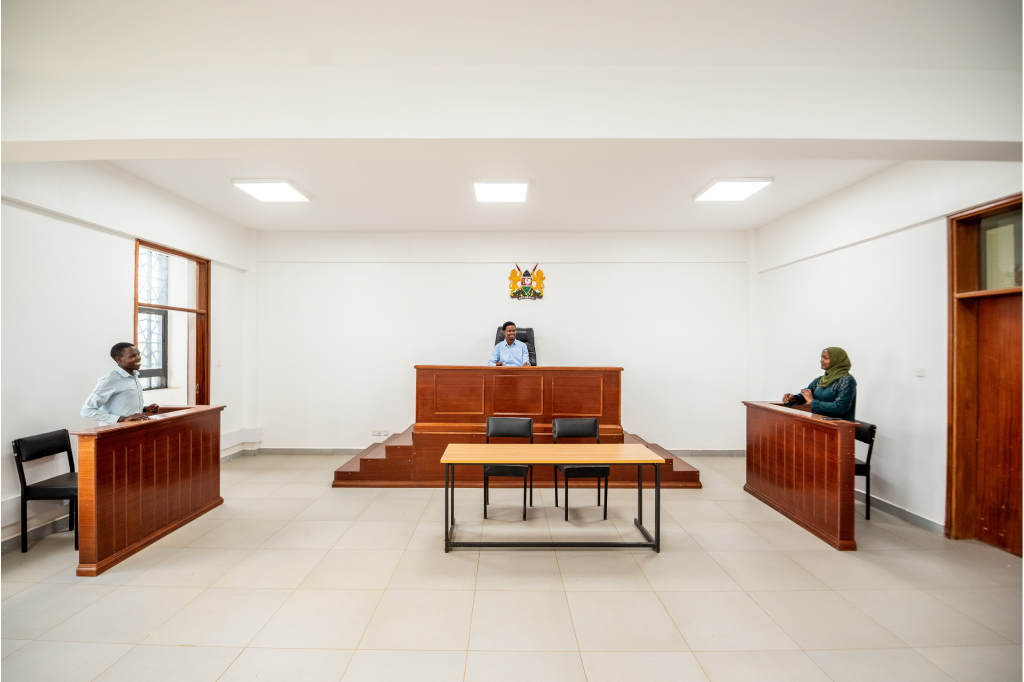
The need for Shari’a Lawyers in Kenya cannot be over emphasized when we say the full-fledged Islamic Banks, Takaful Insurance Companies and opportunities in other financial institutions are calling for personnel well versed with Shari’a and engaged in the legal practice to cater for the ever-growing financial sector in Kenya. The school has highly qualified personnel in Law and Shari’a, with many years of outstanding experience and highly motivated to impart their skills to students and ready to share their experience, successful stories and best lessons. The school is endowed with good learning facilities such as the state of-the art moot court and a library with digital material for teaching and research.
KCSE Mean grade of C+ or its equivalent and grade B in English or Kiswahili
Or
At least three principal passes atA-Level or its equivalent
Or
Degree from recognized University
Or
Credit pass in Diploma in Law from an accredited institution
8 Semesters plus on semeste attachment
Admission Ksh.17,200
Fee Ksh.70,000 per semester
Attachement fee Ksh.10,000
Project fee Ksh.10,000
When you study Law and Shari’a at Umma University, you will have a wide range of career opportunities in private and government legal practice, Non-governmental organizations and in all courts. Upon graduation,one can work as :
Namanga Road, Kajiado County
Box 713-01100, Kajiado, Kenya.
WhatsApp +254 703969000
Garissa: +254 721623705
Mombasa: +254 727759340
Got Questions? Call us
+254 746 790 207
WhatsApp +254 703969000
Garissa: +254 721623705
Namanga Road, Kajiado County
Box 713-01100, Kajiado, Kenya.
Office Location: 2nd Floor Heidelberg plaza, Bellevue Mombasa road
WhatsApp us
Umma University
We firmly believe that the internet should be available and accessible to anyone, and are committed to providing a website that is accessible to the widest possible audience, regardless of circumstance and ability.
To fulfill this, we aim to adhere as strictly as possible to the World Wide Web Consortium’s (W3C) Web Content Accessibility Guidelines 2.1 (WCAG 2.1) at the AA level. These guidelines explain how to make web content accessible to people with a wide array of disabilities. Complying with those guidelines helps us ensure that the website is accessible to all people: blind people, people with motor impairments, visual impairment, cognitive disabilities, and more.
This website utilizes various technologies that are meant to make it as accessible as possible at all times. We utilize an accessibility interface that allows persons with specific disabilities to adjust the website’s UI (user interface) and design it to their personal needs.
Additionally, the website utilizes an AI-based application that runs in the background and optimizes its accessibility level constantly. This application remediates the website’s HTML, adapts Its functionality and behavior for screen-readers used by the blind users, and for keyboard functions used by individuals with motor impairments.
If you’ve found a malfunction or have ideas for improvement, we’ll be happy to hear from you. You can reach out to the website’s operators by using the following email
Our website implements the ARIA attributes (Accessible Rich Internet Applications) technique, alongside various different behavioral changes, to ensure blind users visiting with screen-readers are able to read, comprehend, and enjoy the website’s functions. As soon as a user with a screen-reader enters your site, they immediately receive a prompt to enter the Screen-Reader Profile so they can browse and operate your site effectively. Here’s how our website covers some of the most important screen-reader requirements, alongside console screenshots of code examples:
Screen-reader optimization: we run a background process that learns the website’s components from top to bottom, to ensure ongoing compliance even when updating the website. In this process, we provide screen-readers with meaningful data using the ARIA set of attributes. For example, we provide accurate form labels; descriptions for actionable icons (social media icons, search icons, cart icons, etc.); validation guidance for form inputs; element roles such as buttons, menus, modal dialogues (popups), and others. Additionally, the background process scans all the website’s images and provides an accurate and meaningful image-object-recognition-based description as an ALT (alternate text) tag for images that are not described. It will also extract texts that are embedded within the image, using an OCR (optical character recognition) technology. To turn on screen-reader adjustments at any time, users need only to press the Alt+1 keyboard combination. Screen-reader users also get automatic announcements to turn the Screen-reader mode on as soon as they enter the website.
These adjustments are compatible with all popular screen readers, including JAWS and NVDA.
Keyboard navigation optimization: The background process also adjusts the website’s HTML, and adds various behaviors using JavaScript code to make the website operable by the keyboard. This includes the ability to navigate the website using the Tab and Shift+Tab keys, operate dropdowns with the arrow keys, close them with Esc, trigger buttons and links using the Enter key, navigate between radio and checkbox elements using the arrow keys, and fill them in with the Spacebar or Enter key.Additionally, keyboard users will find quick-navigation and content-skip menus, available at any time by clicking Alt+1, or as the first elements of the site while navigating with the keyboard. The background process also handles triggered popups by moving the keyboard focus towards them as soon as they appear, and not allow the focus drift outside it.
Users can also use shortcuts such as “M” (menus), “H” (headings), “F” (forms), “B” (buttons), and “G” (graphics) to jump to specific elements.
We aim to support the widest array of browsers and assistive technologies as possible, so our users can choose the best fitting tools for them, with as few limitations as possible. Therefore, we have worked very hard to be able to support all major systems that comprise over 95% of the user market share including Google Chrome, Mozilla Firefox, Apple Safari, Opera and Microsoft Edge, JAWS and NVDA (screen readers).
Despite our very best efforts to allow anybody to adjust the website to their needs. There may still be pages or sections that are not fully accessible, are in the process of becoming accessible, or are lacking an adequate technological solution to make them accessible. Still, we are continually improving our accessibility, adding, updating and improving its options and features, and developing and adopting new technologies. All this is meant to reach the optimal level of accessibility, following technological advancements. For any assistance, please reach out to